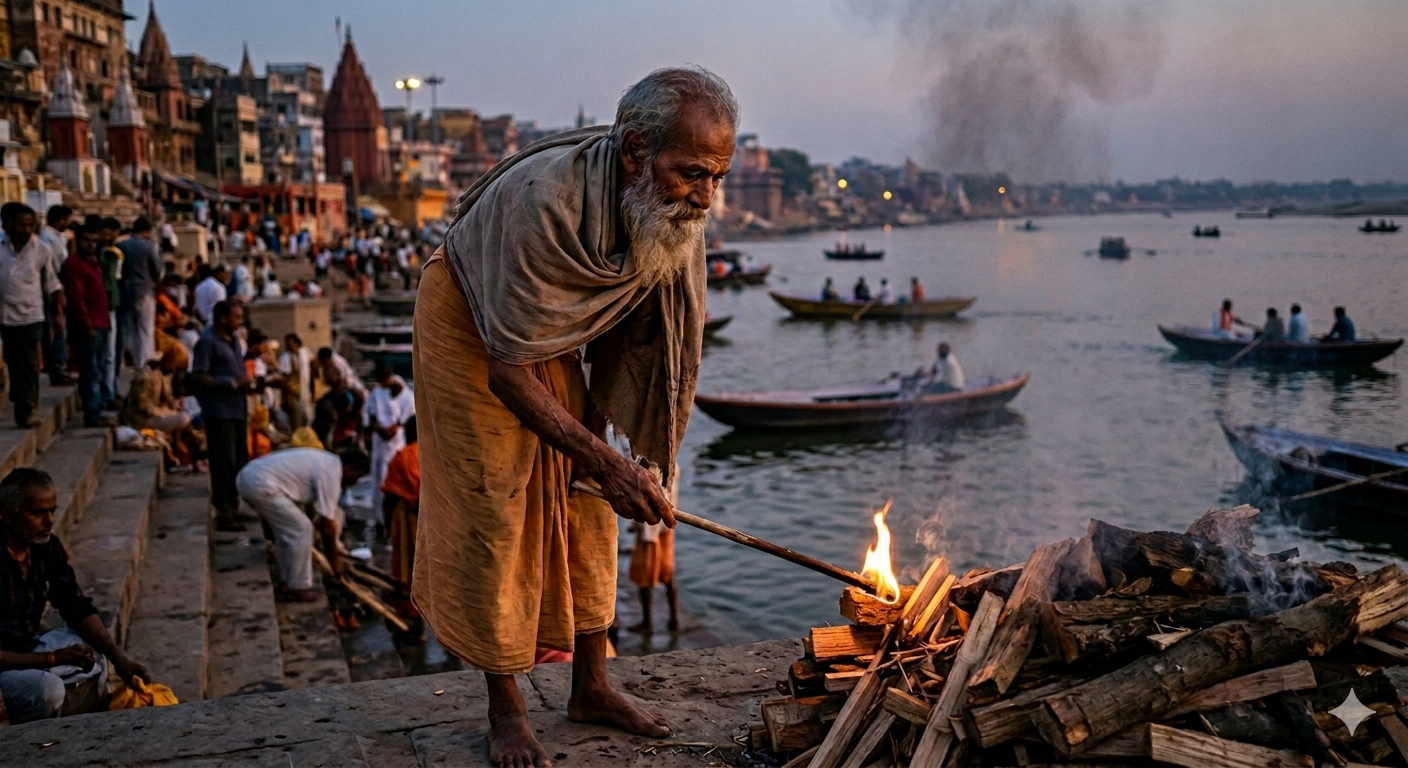
The man who serves at Muktibhavan in Banaras has witnessed more than twelve thousand funeral pyres in his lifetime. He has stood beside thousands of final breaths. He has watched families break down in grief. He has seen wealth, pride, identity, and status reduced to ash.
When you stand so close to death for so long, life begins to reveal its true meaning.
His reflections are not theories from books. They are truths carved out of fire, silence, and farewell.
The first lesson he learned is about equality.
People who arrive at Muktibhavan come from different backgrounds. Some are wealthy, some poor. Some belong to privileged social groups, others to humble families. Some are educated, others not. But before the funeral flame, all differences dissolve.
He realized that if he began judging people based on caste, religion, money, or social status, there would be no peace for them or for him. But when he looked at everyone with equal vision and simple humanity, a deep calm settled within him. In that calmness, he could perform his duty with dignity. Peace comes from seeing others without prejudice.
The second lesson is about purpose.
Many people know what they should do in life, yet they wait for destiny to act on their behalf. But those who lie on their deathbeds often whisper the same regret: I should have tried. Identifying your purpose is not enough. You must act on it. Effort gives meaning to intention.
He also learned the power of habits.
At the end of life, it is not wealth or position that defines a person. It is their character. Truthfulness, compassion, empathy, integrity — these do not arise automatically. They are cultivated through practice. Good habits slowly become values, and values shape the soul of a human being.
Another truth he observed concerns learning.
In the final stage of life, when the body weakens and speech fades, people retreat into their memories. They revisit what they learned and what they experienced. Knowledge and lived wisdom become their only companions. This world holds immense learning, but each of us must choose wisely what to absorb.
Relationships, too, take on new meaning in the shadow of death.
Many conflicts that once seemed unbearable appear insignificant. Differences are often in thoughts, not in people. There is no need to sever ties with loved ones over disagreements. Let go of the harsh thoughts, not the human bond. Forgiveness brings more peace than revenge ever could.
Finally, he speaks of charity.
Set aside a portion of what you earn for good deeds. Dharma is not limited to religion. It means doing good and easing suffering. Many people begin acts of charity only in their final years, realizing that the discomforts they feel are shared by others. Those who receive affection and gratitude from others often leave this world peacefully.
Do not assume that everything you earn belongs only to you. Share a portion. Giving lightens the heart.
After witnessing twelve thousand funeral flames, the man’s message is simple yet profound:
See all with equality.
Live with purpose.
Build strong values through good habits.
Choose meaningful knowledge.
Preserve relationships with maturity.
Share what you have.
When you look closely at death, you begin to understand life
How did this article make you feel? ఈ కథనం మీకు ఎలా అనిపించింది?