The Spiritual, Mythological, and Living Legacy of the Ashvattha
In the spiritual heritage of India, trees are not merely part of nature — they are living embodiments of the divine. Among all sacred trees, the Ashvattha, known as the Peepal tree, holds a place of profound reverence. It is not just a tree. It is a symbol of divinity, eternity, and cosmic truth.
Scriptures describe the Ashvattha as the very form of Lord Vishnu. For this reason, He is also worshipped as Ashvattha Narayana. Archaeological discoveries from the Indus Valley Civilization reveal that this tree was venerated even in ancient times, showing that its sanctity predates recorded history.
Puranic lore narrates that during a celestial battle between the gods and demons, Lord Vishnu once assumed the form of the Ashvattha tree. Because the Lord Himself manifested as this tree, it became eternally sacred. Some traditions also believe that Lord Krishna’s earthly departure took place beneath this very tree. In Buddhist tradition, it was beneath an Ashvattha — the Bodhi tree — that Gautama Buddha attained enlightenment. Thus, it is also known as the Tree of Knowledge.
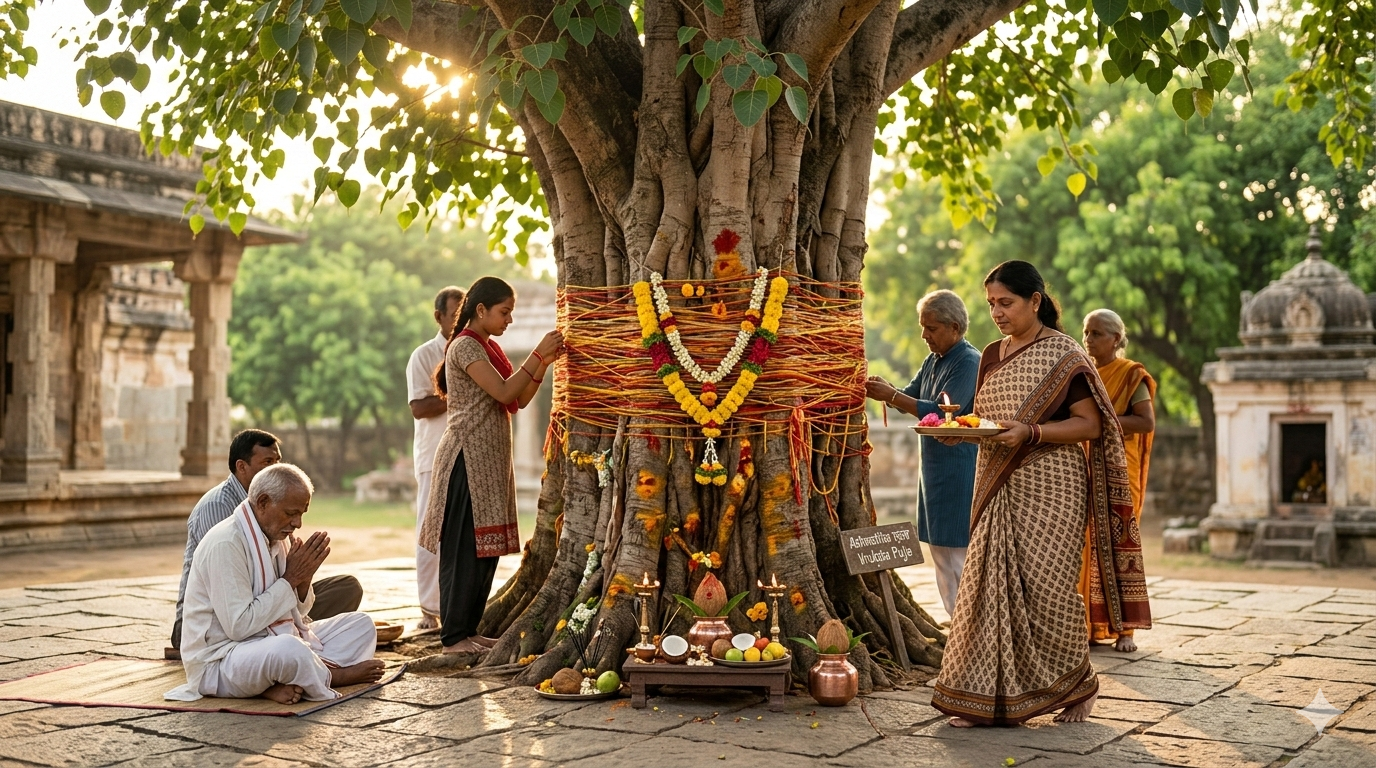
For generations, women seeking the blessing of children have tied red threads or cloth to its trunk or branches, praying with faith and surrender. The scriptures declare that while cutting any tree is sinful, cutting the Ashvattha is considered a grave spiritual offense.
Beyond mythology, the Peepal tree holds immense medicinal value. In traditional Ayurveda, its bark and sacred wood are used in rituals and remedies. Decoctions prepared from its bark are believed to purify the blood, improve digestion, support liver health, and balance bodily imbalances. Its sacred firewood is used in ritual offerings, believed to remove certain karmic and ancestral afflictions.
The Brahmanda Purana beautifully explains its deeper symbolism. The roots of the Ashvattha represent Brahma the Creator. The trunk symbolizes Vishnu the Preserver. The crown represents Shiva the Transformer. Worshipping the tree is thus equivalent to worshipping the divine Trinity.
Its southern, western, and northern branches are believed to be the abodes of divine forces, while the eastern branches are said to house celestial beings and sacred rivers. Its roots symbolize sages, sacred knowledge, and the eternal Vedas. In spiritual philosophy, the tree itself is seen as the embodiment of the sacred syllable Om — the root as A, the trunk as U, and the fruit as M — representing the cosmic vibration of creation.
Because of this profound symbolism, the Ashvattha is often described as a living Kalpavriksha, the wish-fulfilling tree.
Worship and Circumambulation
Devotees first approach the tree with reverence, touch it gently, and recite the Ashvattha Stotram:
Moolato Brahma Roopaya
Madhyato Vishnu Roopine
Agratah Shiva Roopaya
Vriksha Rajaya Namah
Circumambulation must be done with awareness and devotion. Certain months and times are traditionally avoided, as prescribed in ritual guidelines. Devotees walk slowly around the tree in silence, or while chanting the Guru’s name or the Vishnu Sahasranama, offering salutations before and after each circumambulation.
It is believed that performing two hundred thousand circumambulations removes accumulated karmas and grants the four goals of life — righteousness, prosperity, fulfillment, and liberation. Those who pray for children are believed to receive blessings through sincere devotion.
On Saturdays, touching the tree and chanting the Maha Mrityunjaya Mantra is believed to remove fear of untimely death. Reciting hymns to Lord Shani beneath the tree is said to alleviate Saturn-related afflictions.
On rare occasions when Thursday coincides with Amavasya, feeding a learned Vedic scholar beneath the tree is believed to grant the merit of serving countless spiritual seekers. Chanting the Gayatri Mantra beneath the Ashvattha is considered equal to studying the four Vedas.
Planting an Ashvattha tree is said to bring blessings not just to oneself but to forty-two generations.
More Than a Tree
The Ashvattha is not merely botanical life. It is myth, medicine, metaphysics, and meditation woven into living wood and leaves. It is a reminder that nature and divinity are not separate in the Indian spiritual worldview.
To stand beneath a Peepal tree is to stand beneath centuries of faith.
To walk around it is to walk around creation itself.
To worship it is to bow before the eternal rhythm of life.
How did this article make you feel? ఈ కథనం మీకు ఎలా అనిపించింది?