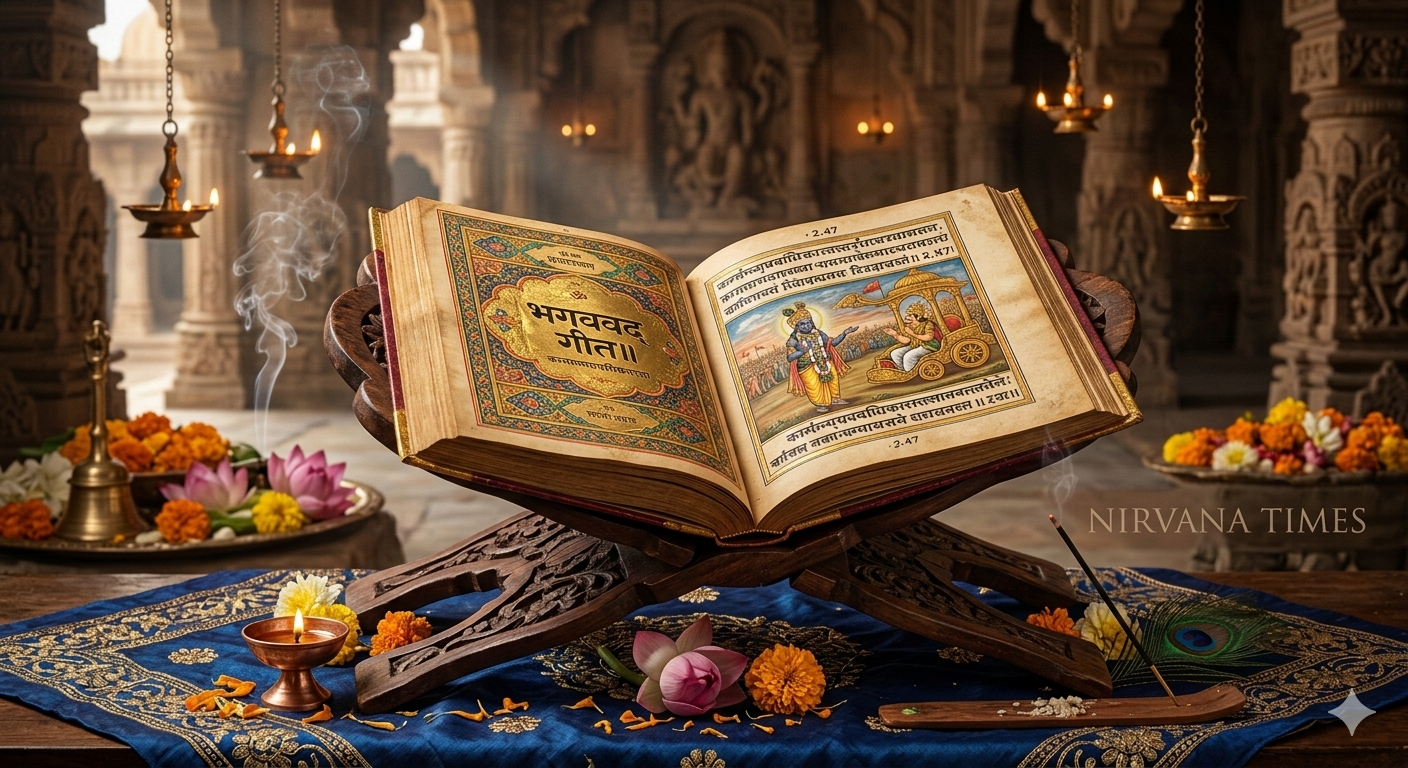
When we wish to understand the meaning of a word, we consult a dictionary. But when we seek to understand the meaning of life itself, where do we turn? The answer, for countless seekers across centuries, has been the Bhagavad Gita.
A dictionary may explain language, but it cannot reveal the inner power of sound. That power is experienced only by the one who meditates upon it. Consider the two syllables Ra and Ma. The name Rama. The saint Tulsidas declared that the repetition of the name Rama alone is enough to carry a soul across the ocean of life. When the name of Rama is lit upon the lips like a flame, it becomes a lamp at the doorway, illuminating not only the one who chants it but also those who hear it.
The Bhagavad Gita carries that same luminous force. Its language is ancient, yet its spirit is eternally modern. Its relevance has never faded, because it speaks directly to the human condition.
The eighteen chapters of the Gita are not called sections or books, but Yogas. In the Ramayana we find Kandas. In the Mahabharata we find Parvas. But in the Gita, each chapter is a Yoga. This is not accidental.
Yoga means union, alignment, integration. The Gita is a scripture that teaches how the individual soul unites with the Divine. It carefully guides the seeker toward that sacred connection. Therefore, its chapters are rightly called Yogas, pathways to union.
A single verse from the Gita, if planted deeply in the heart, can transform consciousness. It can redirect the entire course of one’s life.
At the very beginning, the Gita declares Samatvam Yoga Uchyate — equanimity is Yoga. To remain balanced in victory and defeat, in gain and loss, is true spiritual alignment.
If a person becomes established in this inner steadiness before beginning any action, they will neither swell with pride at success nor collapse in despair at failure. To accept a royal coronation one day and exile the next with the same composure — this is the discipline of Yoga.
Arjuna stood before Krishna trembling, confused, overwhelmed. In that moment, he was not unlike the modern human being, who stands bewildered before life’s conflicts and uncertainties. Arjuna faced Krishna. Today, we stand before our own life.
Then, as now, it is the words of the Gita that can show the way.
Among its many profound teachings, even one is sufficient to steady a person. In the second chapter, we are told to root out weakness from within. In the sixth chapter, we are instructed to uplift ourselves by our own effort. In the twelfth chapter, we are reminded that one who seeks the welfare of all beings draws close to the Divine.
If even one of these teachings truly settles in our heart, we attain the same inner victory that Arjuna did. We become aligned with the consciousness of the Supreme.
There is a story about Maharani Ahilyabai Holkar of Indore, a devoted spiritual practitioner. She once resolved to listen to the Gita in full from a learned scholar. On an auspicious day, the recitation began. The scholar had barely uttered Dharmakshetre Kurukshetre when the queen raised her hand and said, That is enough.
She reflected deeply. Kshetra means field, but it also means the body. Wherever we are, in whatever field of life, we must act according to Dharma. Is that not the essence of the Gita? she asked.
That single phrase pierced her like an arrow of awakening. It revealed her life’s duty in an instant. She felt no need to hear more.
Such is the power of the Gita.
It is not meant to be stored only in the mind or placed reverently in a prayer room. It must be preserved in the depths of the heart. Listening to the Gita is not for entertainment. It is preparation for the battlefield of life.
Krishna did not deliver the Gita to a monk withdrawn from the world. He spoke it to a warrior standing in the midst of conflict.
The message is clear. The Gita is not an escape from life. It is strength to face it.
To understand life, we must approach the Gita — not as a text alone, but as a living guide that unites the human soul with the Divine.
How did this article make you feel? ఈ కథనం మీకు ఎలా అనిపించింది?